
Never Forget....
You can't really know where you are going, until you know where you have been.

A few years ago, when I was writing opinion for the papers (mainly the Irish Independent) I used to listen to radio a lot. I was a current affairs junkie because you can’t have opinions without knowing what is going on.
I still kind of know what is going on, obviously, but I tend to listen and read less current affairs now because I just find the world pretty miserable and dark. And stories of how inhumane humans can be to each other is so profoundly depressing.
And so, when I do turn on the radio and find an hour or more of uplifting and positive stories … well, it’s like the sun suddenly coming out on a cloudy day. And that is what happened last Saturday when I was driving home from Galway and turned on RTE Radio One and found Brendan O Connor chatting to a man with an American accent about his faith. I thought it was Michael Flatley and was going to move the dial (sorry Michael), but it turned out to be another Michael – Mr Buble, Micky Bubbles.
Thankfully he didn’t go into lecture mode about God and stuff, but the conversation turned to love, which was kept just on the right side of schmaltz. In fact, Brendan and Mr Bubbles seemed to bond beautifully on the radio and it was entirely lovely listening.
And it kept on. Because the next up was a Professor Colin Doherty who is a consultant neurologist and also head of the School of Medicine in Trinity College, who talked about introducing a module on love into the curriculum for baby doctors. Again, a lovely, positive, optimistic conversation about how it is possible to teach compassion.
By now I had forgotten the trauma of finding myself being the ONLY PERSON staying in a hotel the previous night (of which more in a future newsletter) as I was doused with lovely thoughts while listening to the radio.
But there was more…. Because after Professor Doherty came journalist, Brian Boyd who suffered a serious cardiac arrest while cycling through Donnybrook recently. He opened the conversation by saying “I was cycling past the Garda Station in Donnybrook when I died” … a very different kind of arrest at the Garda Station (sorry… couldn’t resist). Anyway, he has no memory of what happened but discovered later than a woman who had been at the bus stop came and administered some very serious CPR and saved his life. When the ambulance came, she declined to give her name. So having saved a stranger’s life she just picked up her day and carried on. Brian wanted to thank her. How wonderful is that?
And then on came the lovely Dr Richard Hogan who was talking about some of the women he sees in his psychotherapy practice who are survivors of Mother and Baby homes... Not quite as uplifting content but Richard’s compassion for these women was palpable.
That night myself and himself settled down to watch a movie and I chose ‘Small Things Like These’ which is now on Netflix. I had read the book and loved it. Claire Keegan’s is one of Ireland’s literary greats and her writing and storytelling is sublime. If you have read the book or seen the movie, you will know that the story is set in 1985 and features a Magdalene Laundry in rural Ireland.
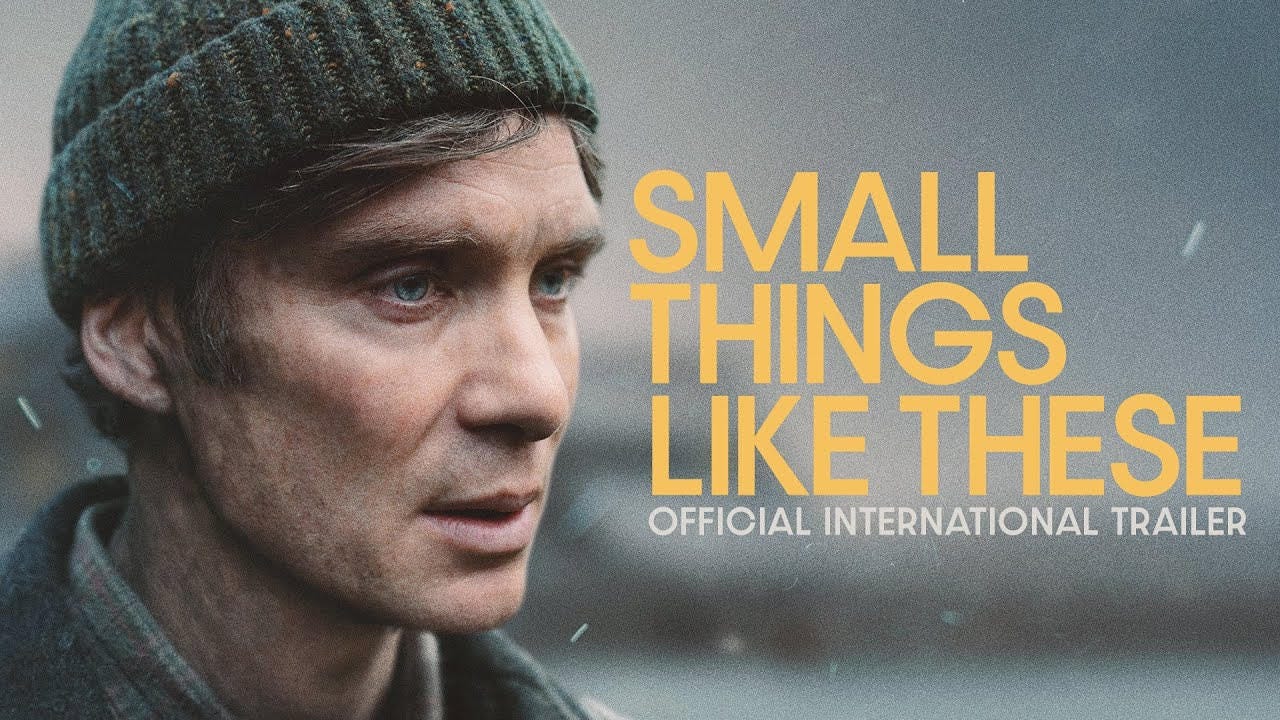
The movie is dark in every sense of the word… my photographer husband just kept muttering ‘it’s very dark’ by which he meant the quality of cinematography. The story which moves very slowly, kind of lost him fairly quickly.
But I was surprised to find myself very moved by it. Somehow when I read the book, the fact that it is set in 1985 missed me. But seeing some things, like the décor in the house, even the mugs and cups, brought me right back to a time I remember very well.
In 1985 I was 23 years old. I worked in the travel business and so travelled probably more than most 23-year-olds, although unlike young people today, my travels were mainly within Europe, although I did also visit New York and Boston back then too.
My generation, who were young adults in the ‘80s, knew well that Ireland was a claustrophobic, unspeakably dull country that may as well have been run by the church. Remember this is the time that spawned punk and bands such like U2 and The Boomtown Rats…. who sang about Dublin being a rat trap.
In 1987, I became an ‘unmarried mother’. I lived in Dublin and my family were supportive, but I knew of local women who ‘disappeared’ to resurface months later saying they had to go either ‘down the country’ to help a sick grandparent or that they went to London for work for a while. No questions were asked.
This was also a time when everyone knew of someone who was gay although it was never remarked on or discussed. We lived literally in a land of secrets and lies.
Watching the story of ‘Small Things Like These’ unfold on my TV on Saturday night I found myself right back in my own family home as I tried to come to terms with the fact that I was going to have a baby and what that would mean for my life and my job. Would I be sacked? How would I be able to care for another human being if I couldn’t work?
And then there was the shame and the judgement; something that I felt both privately and publicly. In my book (Wise Up) and in my first show (Older, Bolder, Wiser) I tell about all the times I had to listen to panel discussions on the media (often The Late Late Show) where panels (usually of men and often men of the cloth) talked about the scourge of ‘unmarried mothers’ who were claiming money from the state (the unmarried mothers allowance was introduced in 1973), going on housing lists (in the days when the Irish Government were still building social housing) and raising kids who were clearly going to be ‘delinquent’ because they ‘had no fathers’. I heard the last point so often that I began to subconsciously believe it.
The shame of being a mother without a husband was profound and not something that a supportive family and friends could shield you from. In my book I tell the story of ‘the phone call’. This is what I wrote:
After my daughter was born, I was off work on maternity leave and so at home. One day I answered the phone, and it was for my dad who was by then retired. It was a pal of his, who like my dad was a retired senior public servant. Although this man, my dad’s friend was someone in fact with a degree of public profile. I could only hear my dad’s side of the conversation naturally and it went like this.
“No, that was Barbara”.
“No, she isn’t working at the moment because, well, em, she has just had a baby”.
“No, no, she didn’t get married.”
“Oh yes, yes, she does know who the father is”.
The tragedy of this story is that I got so angry but not for myself because I think I had already internalised the fact that I was now somewhat sullied by lone motherhood. I was angry that my father had been insulted and slighted by this man’s judgement.
My father was a conservative man. Telling him that I was pregnant remains something I wish I hadn’t had to do because it upset him so much. Although a man of few words I knew he loved me and I also knew that, despite the fact that I hadn’t followed him into the public service (something he desperately wanted me to do), he was proud of me. I remember having told him my news, having to listen to him vomiting in the bathroom, that’s how deeply upset he was by my ‘predicament’.
He couldn’t speak to me for about three weeks. There was no anger. No recriminations, no lectures. Just a silence that burned through the house as he grappled with this new reality. It was awful. I couldn’t afford to move out but also was beginning to believe I couldn’t stay either.
Then one day I arrived home early from work. He was in the kitchen making tea. He turned to me and pulled me into a hug and told me “we will support you; we will stand by you. It’ll be OK.” The relief was enormous. I knew I couldn’t have managed on my own. And he was true to his word. My mother, once she delivered a half-hearted lecture about my being irresponsible in allowing myself to get pregnant, was quite gung-ho about it all and relished this new adventure.
But society’s judgement continued. Looking back now at photos of me from those years I can see just how incensed I was. I wore my hair very short so that even my large, sticky out ears were visible. But what was more visible is the expression I wore most of the time. It clearly shouted, ‘Fuck You’.
Watching ‘Small Things Like These’ brought this Ireland back to life. I found myself in tears as I tried to explain to my (formerly) British husband just how cold a place this country was for women and girls, especially those of us who had stepped outside of our prescribed roles in society. I wasn’t punished by being sent to a laundry, but I was in no doubt that I had brought shame to myself and my family by becoming an ‘unmarried mother’.
The power of good story telling is the ability to make us feel how it feels to be someone else just like the unfortunate young woman in ‘Small Things Like These’. But storytelling can also remind us of bits of our own story that need to be told.
Ireland is not the same place anymore - thankfully. But the strides we have made in women’s equality must never be taken for granted.
As the poet Maya Angelou said “you can’t really know where you are going unless you know where you have been.” Our history, collectively and individually is what makes us who we are. A huge part of that history is how this country treated women and we need to never forget that.
Thank you Brendan O Connor (and his team) for putting together a lovely programme last Saturday which shone a light on the compassion and care and love that was always here, but that was too often in the past smothered by ‘the powers that be’.
Thank you for this beautiful and thought-provoking and gratitude-inducing article, dear Barbara! From what I can see from the outside and the sidelines as a mum of a young European woman studying sciences at Trinity College in Dublin, Ireland has come a long way. And I am sure, this development is also very much thanks to women like you! Thanks so much for your work and your impact! 😘🙋🏻